Technology Migration: When It Makes Business Sense (and When It Doesn’t)
Many software companies and service providers today promote migration services as a standard path toward modernization. It sounds compelling: new frameworks, faster performance, and more maintainable code.
However, migration is almost never a simple technology replacement: it’s an expensive project that can take months and require redesigning parts of the system.
Therefore, the key question is not “which tech is better,” but “will the transition yield real business benefits or will it become a costly initiative without tangible results?”
In practice, many migrations turn out to be situations where the costs of rewriting, testing, and stabilizing the system are enormous, while the business receives no measurable benefit: users don’t notice the changes, the timelines for new features don’t accelerate, and the risks only double.
What Is Software Migration?
In general terms, migration is the process of moving an existing application from one tech stack, framework, or platform to another, and it often forms a central part of legacy modernization efforts by updating outdated systems while preserving core functionality, business workflows, and integrations.
However, migrating an application rarely involves just “switching frameworks.” In practice, it often requires rewriting UI components, adjusting architecture, redesigning CI/CD pipelines, providing security compliance, and retraining teams.
Why IT Infrastructure Migration Is Often Underestimated
In reality, migration costs are frequently underestimated because many critical dependencies are hidden.

Even if an application looks modular, real-world enterprise systems often contain undocumented workflows, tightly coupled components, outdated patterns, and fragile integrations that only become visible during implementation.
Consider an enterprise e-commerce platform: a seemingly isolated product catalog module might rely on custom inventory services, analytics events, and promotional logic scattered across multiple parts of the codebase.
Such a situation often leads to the so-called migration paradox: the greatest investments occur in the initial stages, while the visible benefits appear late, or sometimes not at all.
Organizations may spend months auditing, rewriting, testing, and stabilizing a new system, only to ultimately achieve trivial business improvements.
In other words, migration can turn into a lengthy and costly modernization initiative where the technical changes are real, but the return on investment for the business is minimal.
When Migration Is Justified (High-ROI Scenarios)
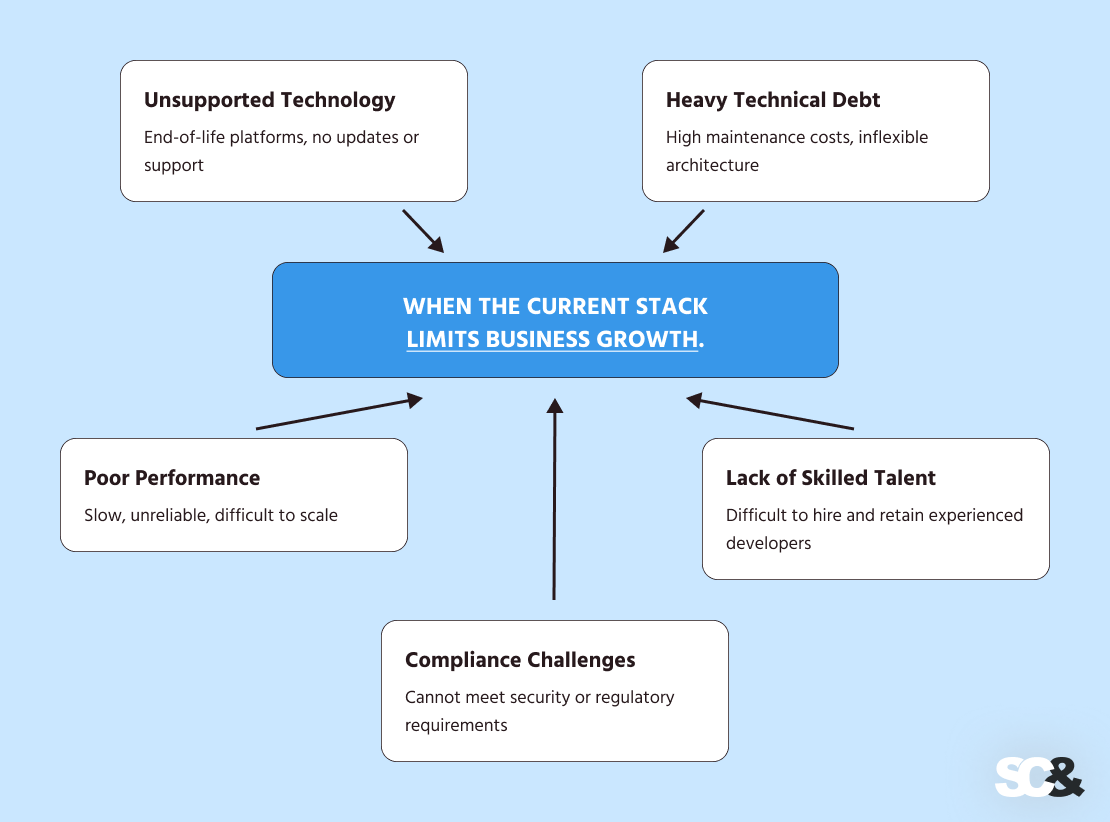
Migration becomes a strategically sound decision when the current stack begins to block business growth, raise problem areas, or limit agility.
When Migration Is Justified (High-ROI Scenarios)
Technology Is No Longer Supported
Migration becomes necessary when the current platform or framework reaches end-of-life. Unsupported tools introduce security vulnerabilities, prevent access to updates, and complicate maintenance.
Examples include AngularJS, which officially reached end-of-life in December 2021, or older versions of the .NET Framework no longer supported by Microsoft. Legacy JavaScript libraries like jQuery 1.x or outdated mobile frameworks such as PhoneGap/Cordova also fall into this category.
In such cases, migrating to a modern framework like React, Angular, or .NET Core provides support and stability, as well as reduces problematic areas.
Technical Debt Blocks the Roadmap
When every new feature requires complex workarounds or extended development time, technical debt slows down further growth.
Legacy code can include tightly coupled UI components, outdated state management patterns, or hard-coded business rules that are difficult to refactor.
For example:
- A legacy CRM system built on an old version of Backbone.js may require multiple interdependent changes just to add a new reporting module.
- An e-commerce platform using jQuery 1.x for interactive components might need extensive rewrites to implement modern payment workflow sequences.
- A financial dashboard relying on outdated server-rendered templates could slow down the rollout of new analytics widgets, increasing time-to-market.
Migrating to a modern stack allows teams to reduce technical debt, simplify maintenance, and develop and deploy new features way faster.
Talent Shortages Affect Delivery
Difficulties in hiring developers proficient in outdated frameworks can limit project development.
Switching to widely used technologies provides access to a broader pool of specialists, simplifying team scaling and accelerating the development process. This approach is often used by companies that need to quickly expand their engineering teams to satisfy business needs.
Performance Impacts Revenue
Applications with slow user interfaces, high infrastructure costs, or limited scalability can directly affect revenue. For example, a legacy travel booking portal built on server-rendered templates might experience long load times during peak traffic.
Rebuilding its frontend with a modern, component-based architecture can greatly reduce page load times, improve responsiveness, and increase booking conversion rates (though the full performance gains often also depend on backend optimizations).
Compliance Requirements Cannot Be Met
Industries such as fintech, healthcare, and insurance often require frameworks that support modern security, audit, and compliance standards.
Older systems may lack the flexibility to integrate the necessary measures, making migration the only way to effectively meet regulatory requirements.
Architecture Cannot Scale
Monolithic or tightly coupled systems can hinder modular development, the implementation of microfrontends, or distributed deployment. Migration (partial or complete) allows teams to implement scalable, easily maintainable architectures that provide long-term growth and functional resilience.
When Migration Is NOT Justified (Most Common Low-ROI Cases)
Even though software developers often promise long-term gains with migrations, not every initiative is actually worth the investment. Understanding the common low-ROI cases helps avoid costly projects that consume resources in vain.
Popularity Alone Is Not a Reason
Adopting a technology simply because it is currently “trendy” rarely leads to meaningful business benefits.
Rewriting a stable product just to use a more popular framework often consumes significant time and budget without improving performance, maintainability, or user experience.
For instance, a well-functioning logistics management system built on a moderately older but stable platform may run as intended for years. Switching technologies solely for hype could stall feature delivery and impact day-to-day operations.
The Current System Fulfills Business Needs
If existing technologies effectively support the product development plan and daily operations, migration may prove to be an unnecessary expense. Companies often underestimate the effectiveness of mature systems.
For example, an inventory tracking platform that reliably directs thousands of transactions per day may not significantly benefit from migration. It would be better to focus on refining existing work cycles or enhancing individual modules.
Cleanup Goals Are Better Served by Refactoring
Not all technical problems require a complete system overhaul. Refactoring problematic components or upgrading individual modules can eliminate bottlenecks faster and at a much lower cost than a complete transition.
Let’s say, updating payment processing logic or report generation modules in a legacy system can reduce errors and improve maintainability without the need to replace the entire application.
Immediate Speed Gains Are Unrealistic
Migration projects inevitably slow down the implementation of new features for several months, as teams learn new approaches, rewrite modules, and conduct extensive testing.
Maintaining two systems in parallel during a phased migration further complicates the process and reduces overall productivity.
For instance, a customer support portal may see delayed rollout of new ticketing features if the shift is attempted mid-year, potentially affecting service KPIs.
Lack of Clear Ownership or Success Metrics
Without clearly specified goals, KPIs, or ownership, a transition initiative becomes open-ended and expensive. Teams may spend months rewriting modules or reconfiguring architecture without visible results.
For instance, a marketing automation platform could undergo a full tech migration, yet still fail to improve campaign launch speed if success metrics are not established upfront.
The Angular → React Example: Why Migration Produces Weak ROI
Application re-platforming can sometimes feel like the natural step forward, especially when a technology seems “outdated” or when the market advertising suggests a switch.
However, in many cases, migration may not be the wisest choice. A clear example comes from frontend development, particularly when a company decides to move from Angular to React.
Moving an existing Angular application to React is often assumed to modernize the frontend and reduce maintenance costs, but this assumption can be misleading.
First, it’s important to note that older Angular applications are not automatically “legacy.” Often, it can be much simpler and more reasonable to upgrade an existing Angular app to the latest version rather than rewriting it from scratch.
Upgrading keeps the existing codebase and avoids the massive upfront expenses associated with a complete rewrite. Rewriting an entire frontend in a new framework is always more expensive, and business stakeholders are rarely willing to incur unnecessary losses.
According to rough estimates, 90% of companies would prefer to maintain a legacy Angular application and pay for continued support rather than invest a large sum in a full transition that may bear new bugs.
Of course, there are situations where migration could make sense. For instance, if the existing Angular version is too old to upgrade feasibly, or if the current architecture prevents implementing modern features, a switch to another framework might be justified.
But even in such cases, it is necessary to conduct a thorough analysis and compare the expenses of creating and maintaining the current Angular-based system with the potential costs of a new technology.
Developer availability, salary differences, and familiarity with related technologies (e.g., developers experienced in Nest.js often already know TypeScript and Angular concepts) can make transitioning to a new framework easier than it seems.
This way, the performance benefits of switching to React seldom justify the cost and time needed for a full migration. A React-based version of the same application is unlikely to have performance gains large enough to offset the time of re-development work.
In most cases, retraining existing developers or gradually modernizing the current Angular application proves far more practical and financially appropriate.
How to Evaluate Migration ROI Before Approving It
Before committing to re-platforming, it’s important to understand if the effort and cost will actually bring value. Here is a structured plan to help you evaluate the return on investment.
- Assess Company Goals: The first step is to recognize the main reasons for re-platforming. Is it to improve performance, reduce expenses, access a larger talent pool, or scale a system? If the current technology already supports these goals, migration may not be justified.
- Estimate Costs: Calculate the total effort required, including rewriting code, redesigning architecture, retraining developers, testing, and temporarily running parallel systems. Don’t forget the costs for maintaining the new system during the transition.
- Compare Benefits vs. Risks: Consider both tangible and intangible benefits, such as faster development, better UI performance, or reduced technical debt. Balance these against delayed feature delivery, potential bugs, and business disruption.
- Factor in Talent and Resource Availability: Evaluate if your team has the necessary skills for the new technology. Hiring developers for a new framework or retraining existing ones adds time and cost.
- Use Metrics and Benchmarks: Whenever possible, quantify expected gains. For example, estimate improvements in load times, feature delivery speed, or maintenance. Compare these figures against migration costs to see if the project is likely to pay off.
| Factor | What to Check | If Risk Is High… | Best Action |
| Agility vs. Stability | Can the software adapt quickly to change? | Architecture is too rigid | Consider transition |
| Hiring Risk | Is it hard/expensive to hire for the current stack? | Talent pool is shrinking | Migration may pay off |
| Roadmap Pressure | Does tech slow feature delivery? | Features take too long | Switch or modernize |
| Compliance & Security | Can the solution meet regulations and audits? | Gaps cannot be fixed easily | Migration justified |
| Architecture Limits | Can it scale and evolve? | Monolith blocks growth | Transition or modularization |
| User Performance Impact | Does UI speed affect retention/revenue? | Users feel the lag | Optimize or migrate |
A Practical Decision Framework
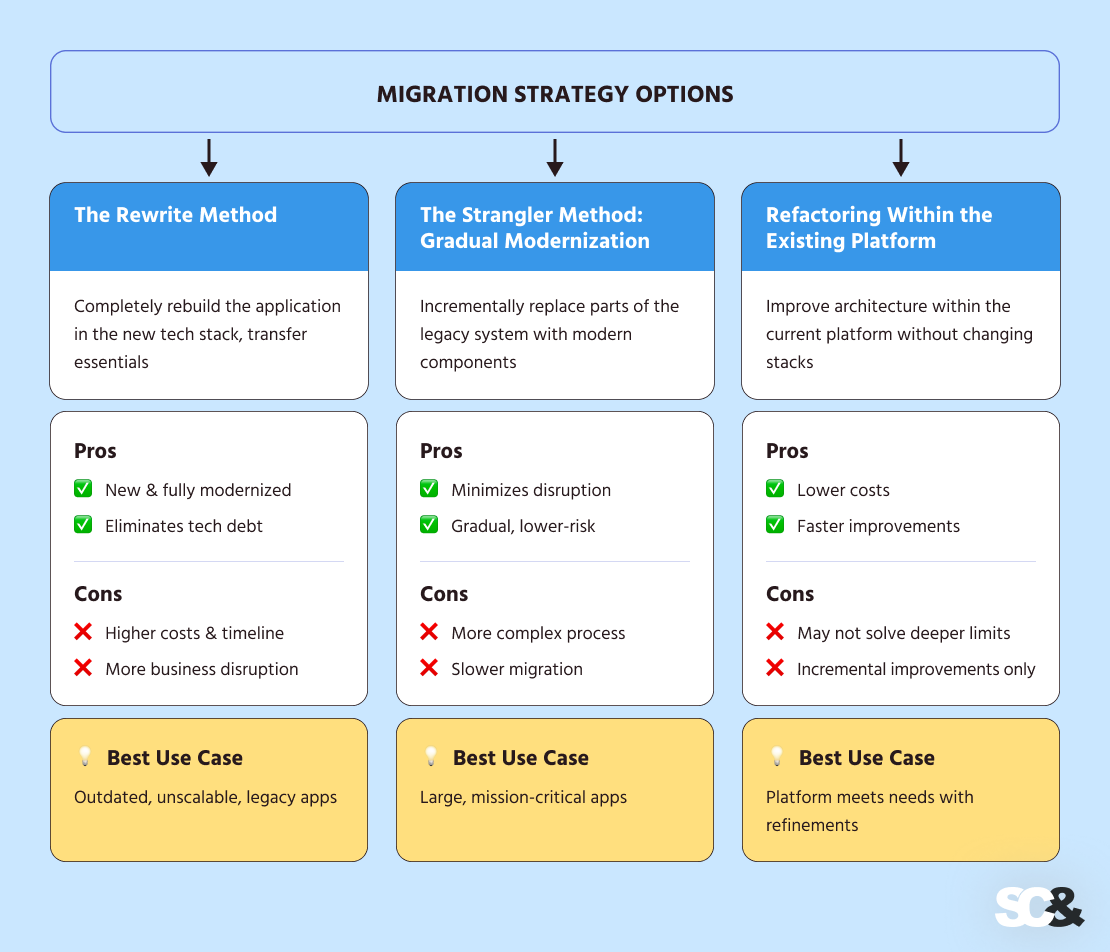
Migration Strategy Options and Trade-Offs
Upgrading an application can follow different paths, and it’s important to distinguish which approaches truly constitute a re-platforming versus simpler modernization actions.
The Rewrite Method
This strategy involves creating a completely new application, transferring only the most essential business logic from the old system.
- Pros: Provides a fully modernized system, reduces accumulated technical debt.
- Cons: High initial costs, longer implementation times, and potential disruptions to business operations during the transition period.
- Best Use Case: Suitable when the existing application is outdated, heavily coupled, or cannot scale to satisfy future requirements.
The Strangler Method: Gradual Modernization
Instead of rewriting everything at once, this approach replaces parts of the legacy software gradually. New modules are built in the target technology and integrated alongside the old software until the legacy system is fully retired.
- Pros: Minimizes disruptions to business operations, allows for the distribution of costs over time, and enables testing and verification of components before complete replacement.
- Cons: More complex to manage multiple systems, potentially slower overall migration, requires careful integration planning.
- Best Use Case: Ideal when the application is large, mission-critical, or cannot be shut down for a complete overhaul.
Refactoring Within the Existing Platform
Sometimes, modernization does not require switching technologies at all. Refactoring or improving architecture within the current platform can resolve technical debt, improve performance, and support new features without a full migration.
- Pros: Lower costs compared to a full switch, faster implementation, and preservation of existing investments in the current platform.
- Cons: May not solve deeper architectural limitations, incremental improvements may eventually reach a ceiling.
- Best Use Case: When the platform is still supported, and current technology fulfills the company’s needs with minor improvements.
Conclusion
Technology migration can be a great move, but only when it solves a real problem, not when it follows market hype.
In most cases, the highest value comes from treating migration as a strategic modernization initiative: reducing technical debt, improving delivery speed, and enabling future scalability.
Before approving a transition, decision-makers should evaluate whether the current solution can be upgraded, refactored, or partially modernized at a lower cost. If a full transition is still justified, the project must be driven by clear business goals, realistic ROI expectations, and a structured roadmap focused on stability and continuity.
Frequently Asked Questions (FAQs)
Can you define a migration transition?
A migration transition is the process of moving an existing application, system, or platform from one technology, framework, or environment to another while preserving its core functionality, workflows, and integrations.
When does software migration make business sense?
Migration is an advantage when the current tech blocks growth, increases operational costs, creates security or compliance risks, or prevents the product roadmap from moving forward at a reasonable speed.
How do you know if migration will deliver ROI?
A switch has strong ROI when it solves a measurable business problem, such as reducing maintenance costs, improving scalability, or accelerating releases, caused by unsupported platforms.
How much does a typical migration cost?
Re-platforming cost (including cloud migration) depends on application size, architectural complexity, data dependencies, and how much of the system must be rebuilt versus reused. Accurate estimates usually require an audit.
Will software transition disrupt existing users?
It can, but disruption is avoidable. A phased approach (incremental replacement) helps keep the system running while new modules are introduced gradually.
What is the difference between migration, modernization, and refactoring?
Migration changes the platform or tech stack. Modernization improves architecture, deployment, or scalability without necessarily changing the stack. Refactoring restructures code internally while keeping the same functionality.