Top 15 Web3 Development Companies in Dubai 2026
Over the past two years, Web3 has seen a major comeback across multiple areas. By September 2024, there were 220 million active crypto addresses worldwide, more than three times the number at the end of 2023.
DeFi active addresses jumped nearly threefold, with around 7 million transactions happening every day. Stablecoins, in turn, continued to be widely used, managing more than $2.6 trillion in transactions.
This global wave in decentralized tech adoption has not left the UAE behind. Dubai, in particular, is positioning itself as the leading hub for blockchain and Web3 development services — and for good reason.
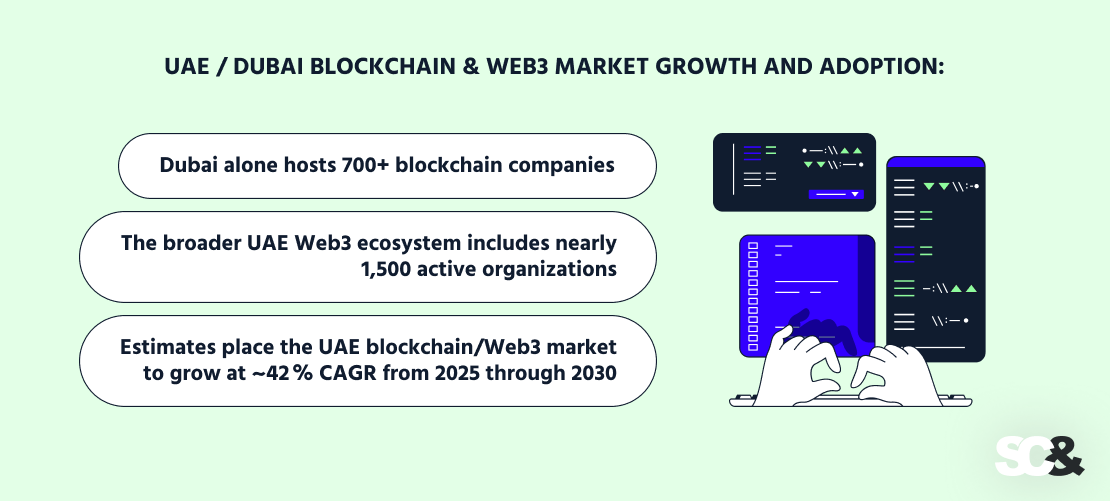
By 2025, the UAE attracted hundreds of blockchain startups and projects building Web3 solutions. So if you’re seeking a place with a large pool of skilled Web3 companies and independent developers, Dubai offers one of the most active and diverse ecosystems to choose from.
Why Is Dubai Leading in Web3 Adoption?
Not long ago, Dubai was primarily known for being an oil‑era city. With the rise of decentralized technologies, however, Dubai geared towards becoming the world’s most alluring hub for blockchain and Web3.
In many ways, this became possible thanks to truly world-class infrastructure, business-friendly regulations, and forward-thinking government initiatives.
For example, the Virtual Assets Regulatory Authority, or VARA, creates a stable, predictable atmosphere for virtual‑asset and blockchain firms, in turn making Dubai a magnet for developers, investors, and enterprises seeking to capitalize on the growth explosion in Web3.
The Dubai Metaverse Strategy, respectively, reinforces the city’s long-term adherence to emerging technologies by aiming to create thousands of virtual-economy jobs, attract global Web3 companies, and integrate immersive technologies into education, retail, real estate, and government services.
The other main factor is the business climate of Dubai. It boasts zero personal income tax, ease of company setup, and a host of specialist free zones like DMCC Crypto Centre and Dubai Internet City, where hundreds of blockchain development companies are already up and running.
Access to capital, talent, accelerators, and networking in these hubs creates a formidable local ecosystem.
Further, the role of Dubai as an international finance and trade center makes it a natural testing ground for real-life blockchain applications: digital identity, supply-chain transparency, tokenized assets, real-estate transactions, and cross-border payments.
Local enterprises and government entities can actively experiment with and deploy decentralized technologies, accelerating adoption from the inside out.
Top Web3 Development Companies in Dubai to Watch in 2026
Based on recent industry lists and market sources, here are 15 of the most reputable Web3 and blockchain development firms in Dubai for 2026. We split them into those often cited as major players vs. recognized specialists, to give a broad picture.

1. SCAND
SCAND is a well‑established custom software development and outsourcing company, with more than 25 years on the market, a team of over 250 engineers, and a portfolio ranging from startups to Fortune‑500 clients.
Historically, SCAND focused on web, mobile, desktop, and enterprise software — ERPs, CRMs, data‑heavy systems, SaaS products, and more.
More recently, however, the team expanded into Web3 & blockchain services, offering a full range of decentralized solutions: custom decentralized applications (dApps), DeFi platforms, crypto wallets, NFT marketplaces, smart‑contract development (for tokens, DEXs, NFT contracts, staking, etc.), and multichain & cross‑chain solutions.
SCAND also supports private‑blockchain development for clients with high security or compliance needs, developing permissioned networks, private dApps, private wallets, and custom blockchain infrastructures.
On top of that, SCAND supports full‑cycle delivery: from requirements and planning to UI/UX design, development, QA/testing, deployment, maintenance, and even post-release support or team augmentation.
Main strengths:
- Breadth and diversity of expertise — SCAND isn’t limited to blockchain: they handle everything from classic enterprise software, web and mobile applications, to AI/ML and blockchain. That means they can mix legacy systems or traditional enterprise logic with decentralized architectures if needed.
- Well-arranged processes — SCAND relies on established methodologies (DevOps, QA, UI/UX, multi‑stack development) and has ISO‑level quality & security certifications (ISO 9001 for quality management, ISO/IEC 27001 for information security).
- Flexibility in engagement models — fixed‑price, time & material, dedicated teams, or outstaffing — which gives clients freedom to choose what fits their needs (from full product build to staff augmentation).
- Real‑world experience across industries — they’ve delivered projects in logistics, fintech, healthcare, gaming, and more. This cross‑industry exposure is valuable for Web3 projects aiming for real-world adoption beyond pure crypto or blockchain natives.
Best fit for: Hybrid solutions, full‑cycle, end-to-end development partner, team augmentation, or outsourcing.
2. Blocktunix
Blocktunix is a focused blockchain/Web3 development agency that markets itself as an end-to-end provider (smart contracts, multi-chain dApps, NFT marketplaces, wallets) and appears frequently on Web3 company listings for the UAE.
Their advantage is breadth (they cover many Web3 verticals and stacks), so they’re often chosen by startups that need a quick, full-stack build.
- Main strengths: Wide Web3 stack support, from wallets and smart contracts to NFT, DeFi, and games — good for companies wanting a one-stop shop.
- Best fit for: Early-stage startups or medium businesses aiming for rapid deployment of DeFi/NFT/gaming/social products.
3. Accubits Technologies
Accubits combines blockchain and AI expertise and emphasizes enterprise-grade Web3 platforms, tokenization, SSI (self-sovereign identity), and large dApp projects.
They have a history of work with government and enterprise clients and present a track record that suggests capacity for complex, compliance-sensitive projects.
- Main strengths: Enterprise-grade architecture, multi‑chain and AI + blockchain integration, experience with regulated (public-sector) domains.
- Best fit for: Large-scale or compliance-heavy projects, such as fintech, real‑estate tokenization, enterprise blockchain integration, and hybrid AI‑blockchain systems.
4. Web3 Solutions
Web3 Solutions (UAE-oriented) places itself as a local specialist offering smart-contract development, NFT systems, private chains, and tailored decentralized architectures.
Their core strength is local market focus and Web3-only positioning — useful if you want a partner that understands the UAE inner kitchen and regulatory context.
- Main strengths: Specialization in Web3-only development, understanding of decentralized architectures and crypto-native product needs.
- Best fit for: Web3-first projects that don’t need legacy system integration — e.g., NFT marketplaces, new dApps, tokenized platforms made from the ground up.
5. TekRevol
TekRevol is a digital-transformation firm with a blockchain/Web3 practice that pairs web & mobile app development with blockchain back ends (tokens, smart contracts, enterprise chains).
Their value is mainly product design + engineering, which makes them a match when UX, mobile app experience, and prompt productization matter alongside blockchain logic.
- Main strengths: Strong product and UX/design orientation, combined with Web3/back‑end engineering — good for consumer-facing blockchain apps.
- Best fit for: Projects where blockchain underpins a user‑facing product, such as mobile wallets, social/gaming apps, NFT marketplaces, or consumer DeFi.
6. Block Gemini
Block Gemini is a Dubai-based consultancy and app development house that targets enterprise blockchain and hybrid solutions (blockchain + legacy systems, IoT, supply chain, etc.).
They’re best suited for organizations needing end-to-end transformation, tokenization of assets, or complex integrations where blockchain is one component of a larger system.
- Main strengths: Enterprise-level architecture, hybrid integration (blockchain + legacy + IoT), consulting + execution qualification.
- Best fit: Large enterprises or organizations wanting blockchain adoption within complex systems — real estate, logistics, supply‑chain, asset tracking, and regulated industries.
7. Blockchain Founders Fund
Blockchain Founder Fund is primarily a venture/accelerator group (investor + ecosystem builder) that runs funding, incubation, and sometimes product support for Web3 startups — less of a pure dev shop and more of a strategic partner for projects that want capital plus mentorship and introductions.

If you’re seeking both development and funding/market access, they can be a useful collaborator; for pure engineering work, however, it’s better to pair them with a separate dev partner.
- Main strengths: Strategic backing, ecosystem access, funding + mentorship + potential guidance beyond just development.
- Best fit for: Early-stage startups seeking capital, mentorship, and a network, potentially combined with development partners for execution.
8. Bluechip Computer Consultants (Bluechip)
Bluechip performs as an IT and systems integrator in the Gulf region and lists capabilities in managed IT and software services.
Their strength is operational support and regional availability — they’re a practical option for teams needing local managed services or smaller blockchain integrations.
- Main strengths: Local/regional presence in the Gulf/Middle East, IT integration and support background, potential ease of collaboration for regional clients.
- Best fit for: Businesses in the Middle East needing Web3 integration with existing systems and local support — smaller blockchain integrations or pilot projects.
9. Cryptex Technologies / Cryptex (note: two similarly named entities)
Frankly speaking, there are multiple “Cryptex” brands: Cryptex Finance (on-chain indices & DeFi products) and Cryptex Technologies (a software house focused on Rails/web apps).
If you mean Cryptex Finance, they build tokenized index products and DeFi instruments and are active in the region; if you mean Cryptex Technologies, they are a traditional web/software development firm with some blockchain interest.
Nonetheless, both deserve due diligence depending on whether you need financial-product expertise (Cryptex Finance) or web engineering (Cryptex Technologies).
- Main strengths: Development flexibility; if crypto‑product oriented — they have DeFi/tokenization knowledge; if software‑oriented — they may offer general development services with blockchain add-ons.
- Best fit for: Smaller or mid‑size projects where flexibility is more important than enterprise-grade pedigree — but only after verifying which entity exactly.
10. IdeaSoft
IdeaSoft markets itself as a blockchain & fintech development company (multi-chain dApps, tokenization, DeFi stacks) with European dev centers and cross-border delivery.
They present numerous blockchain projects and are positioned for startups and mid-market firms that want full-stack blockchain engineering plus fintech domain knowledge.
- Main strengths: Fintech & blockchain specialization, cross-border delivery, likely lower cost vs in-house builds, reasonable team size.
- Best fit for: Startups or mid-market fintech firms needing a full-stack development partner, especially if they don’t require a local Middle East presence.
11. Bacancy Technology
Bacancy is a large offshore/nearshore engineering company with explicit blockchain hiring and Web3 services (smart contracts, NFTs, dApps) and an established UAE presence.
Their advantage is scale; you can quickly staff with experienced blockchain engineers, which is appealing to projects that need dedicated teams or long-term support.
- Main strengths: Large engineering capacity, availability of blockchain-skilled staff, adaptable scaling, and outsourcing model.
- Best fit for: Projects needing team augmentation, dedicated blockchain teams, or long-term development support without assembling an in-house team.
12. Interexy
Interexy is a Web3 development studio with strengths in UI/UX, gaming, NFT marketplaces, and blockchain back ends — beneficial when frontend impression and product design matter (e.g., gaming, phygital retail, NFT platforms).
- Main strengths: Strong design/UX + Web3 stack, suitable for NFT, gaming, marketplace, or frontend-heavy applications.
- Best fit for: Consumer-facing products — NFT marketplaces, blockchain games, or apps where UX & design matter a lot.
13. EvaCodes
EvaCodes is a Web3-specialized engineering team (multi-chain, DeFi, NFTs, smart contracts) that appears repeatedly on curated “among the top Web3 in Dubai” lists and has recognitions on Clutch/industry directories.
They’re noted for security focus and multi-chain tooling, and may be particularly useful for projects that require audited smart contracts and cross-chain deployments.

- Main strengths: Web3‑specialized team, agile approach, multi-chain, and modern toolset.
- Best fit for: Small-to-mid ventures that want a lean, specialized partner to manage blockchain logic, smart contracts, and simple dApps/NFT platforms.
14. Innowrap Technologies
Innowrap is a mature software development and staff-augmentation company offering app, web, and enterprise solutions with an international client base; they also list blockchain as one of their service areas.
Their advantage is trustworthy product development and headcount flexibility (staff augmentation), making them suitable as an extended team for blockchain initiatives rather than a boutique Web3 pioneer.
- Main strengths: Reliable software delivery, staff augmentation, and the ability to integrate blockchain as a part of larger projects.
- Best fit for: Enterprises or companies with existing projects or legacy systems that need to add blockchain features without heavy restructuring.
15. TribalScale
TribalScale is a global innovation partner (product strategy, AI, engineering) with offices and activity in the UAE; they offer Web3 engineering, strategy, and digital-product expertise for enterprises.
Their strength is product design + engineering at scale, which fits enterprises that want product-level leadership combined with rich engineering and modern architectures rather than pure smart-contract shops.
- Main strengths: Product strategy + engineering at scale, cross-industry experience, global delivery capabilities.
- Best fit for: Enterprises or businesses seeking to create or remake large-scale digital products with Web3 foundations.
Additional Notable & Specialist Web3 Developers
In addition to the large and broad firms, there are many smaller or more specialized developers and studios (in Dubai or the UAE) that focus on narrow verticals. These firms can be extremely valuable when your project needs depth in one domain rather than full-stack breadth.

1. NexIT
NexIT is a UAE-based technology and consulting company offering Web3, blockchain, and digital-transformation solutions for enterprises.
Their Web3 practice spans blockchain integration, dApp development, tokenization frameworks, and cloud + data-governance services aligned with UAE compliance requirements.
The company also focuses heavily on Web3 adoption: integrating blockchain with existing IT ecosystems, setting up secure workflows, and helping organizations move to decentralization without disrupting legacy systems.
Their services include private/permissioned blockchain deployment, smart-contract design, and end-to-end implementation of blockchain-enabled business processes.
2. Digital Gravity
Digital Gravity is a Dubai-based Web3 development agency offering a mix of decentralized-application development, smart-contract engineering, Web3 game and metaverse development, and NFT marketplace creation.
Their Web3 team works with Solidity, Rust, Substrate, and modern JavaScript frameworks, which allows them to create both consumer-facing and enterprise-grade decentralized apps.
Digital Gravity positions itself as a full-stack Web3 provider, offering design, UX, smart contracts, infrastructure, DevOps, and ongoing maintenance. Their portfolio extends into NFT ecosystems, DeFi apps, cross-chain integrations, token development, and blockchain consulting services.
They target both startups launching new Web3 products and established businesses looking to integrate blockchain functionality into existing products or workflows.
3. Digital Buddha
Digital Buddha is a Web3-native creative and development agency focused on blockchain products, NFT ecosystems, Web3 gaming, and decentralized applications.
The company blends creative direction with blockchain engineering, positioning itself as a partner for Web3 brands, digital-asset projects, and emerging decentralized communities.
They also offer marketing, community-building, and brand strategy — making them useful for new Web3 ventures that need both product and ecosystem support.
Digital Buddha works with multiple chains (Ethereum, BNB Chain, Polygon, and others), delivering Web3 products for entertainment, gaming, digital collectibles, and branded loyalty programs.
| Company | Focus | Best For |
| SCAND | Full Web3 stack: dApps, smart contracts, NFT, wallets, enterprise blockchain. | Complex or enterprise-grade Web3 builds. |
| Blocktunix | Fast MVPs, DeFi, NFTs, multi-chain dApps. | Startups needing quick launch. |
| Accubits | Enterprise blockchain, AI + Web3, tokenization. | Regulated/large-scale projects. |
| Web3 Solutions | Pure Web3 development. | NFT and token-based platforms. |
| TekRevol | Mobile + Web3 apps. | Consumer-facing Web3 products. |
| Block Gemini | Blockchain + legacy/IoT integration. | Corporate blockchain adoption. |
| Blockchain Founders Fund | Funding + ecosystem support. | Early-stage Web3 startups. |
| Bluechip | IT + light blockchain integration. | SMEs needing local support. |
| Cryptex | Mixed DeFi/software work. | Smaller flexible Web3 builds. |
| IdeaSoft | Fintech + Web3, tokenization. | DeFi and fintech startups. |
| Bacancy | Large dev teams, smart contracts, dApps. | Team augmentation for Web3. |
| Interexy | Web3 UI/UX, NFT, gaming. | NFT and blockchain gaming. |
| EvaCodes | Security-focused dApps, NFTs. | Mid-size Web3 projects. |
| Innowrap | Web/mobile + optional blockchain. | Adding Web3 features to apps. |
| TribalScale | Product strategy + Web3 for enterprise. | Digital transformation with blockchain. |
Top Web3 Development Companies in Dubai — Comparison Table (2026)
Web3 Use Cases Actively Developing in Dubai
What should those looking for Web3 development in Dubai look out for? Though the city is a global hotspot for blockchain and decentralized technologies, understanding the most active use cases can help make better decisions on a software development provider.
Real‑Estate Tokenization & Blockchain Land Registry
One of the most advanced Web3 use cases in Dubai is property, thanks to the work of the Dubai Land Department (DLD).
In March 2025, they launched a real‑estate tokenization pilot, which made Dubai among the first in the Middle East to allow property title deeds to be represented as blockchain tokens.
That means properties (or fractions of them) can potentially be bought, sold, or traded more transparently and with lower entry barriers for smaller investors.
Decentralized Finance (DeFi) & Crypto‑native Finance Platforms
The financial sector in Dubai is seeing a wave of the next web era adoption too. DeFi applications, stable-coin-based remittance and payment services, and crypto‑asset platforms are increasingly active.
This is mainly contributed to by the favorable regulatory environment (thanks to VARA and financial free zones), which makes Dubai attractive to DeFi and blockchain‑finance projects seeking legal clarity and structural stability.
Digital Identity, Government Services & Decentralized Public Infrastructure
Dubai’s ambition to build a “smart‑city + Web3” hybrid includes applying blockchain for different public services.
Lots of initiatives, such as decentralized identity (or DID) infrastructures, aim to give residents secure, self‑sovereign identity, usable across government and private services.
Already, many public‑sector workflows — from property registration and land deeds to procurement, notarization, customs, and other civic services — are being considered for blockchain‑based smart‑contract automation.
This approach promises less bureaucracy, fewer intermediaries, and easier cross‑department data sharing — ideal for a booming, globally‑oriented city like Dubai.
NFTs, Digital Art, Metaverse & Virtual Experiences
The blockchain-powered web in Dubai obviously isn’t limited to finance or real estate. The NFT market, digital art exhibitions, and metaverse‑linked retail or entertainment use cases are gaining traction.
Combined with the city’s official Dubai Metaverse Strategy and strong infrastructure (high-speed internet, cloud, free zones, global connectivity), this sets the stage for immersive virtual experiences: virtual real‑estate, metaverse retail, digital events, virtual offices, and more.
Supply‑Chain, Trade Logistics & Real-World Assets (RWA) Tokenization
Given Dubai’s role as a global trade and logistics hub, the decentralized web is being used to modernize supply chains, improve traceability, and tokenize commodities or trade goods.

Blockchain‑based supply‑chain platforms can improve transparency, reduce fraud, promote provenance tracking, and simplify trade‑finance processes — which is critical for import/export businesses, logistics companies, trade‑forwarding, and commodities trading in Dubai’s global market.
What to Watch Out For When Exploring Dubai Web3 App Development (Challenges & Caveats)
Even though Dubai’s Web3 scene is booming, it’s not a frictionless paradise. Immediate growth sometimes leads to a fragmented vendor terrain — not all development agencies are equal in reliability or technical depth.
It may be tempting to go with cheaper providers, but given regulatory scrutiny (especially around virtual assets), it is better to work with firms that understand compliance matters.
Also, as more firms crowd into free zones and accelerators, competition for talent, office space, and funding may increase, which could multiply costs or slow down timelines for new projects.
This way, it’s always better to aim for quality and clarity: pick vendors with proven track records, transparent DevOps / security standards, and ideally some local/regional experience.
Frequently Asked Questions (FAQs)
Why is Dubai attractive for Web3 startups versus other global hubs?
Mostly because Dubai combines regulatory clarity (thanks to VARA and supportive policies), a tax‑friendly regime, strong infrastructure, access to global capital, and a business‑friendly atmosphere.
Is the Web3 adoption in Dubai just hype, or real traction?
There is real traction. As of 2025, there are hundreds of blockchain companies in Dubai. Market forecasts point to an approximate 42% CAGR toward 2030, suggesting gradual growth, not just a temporary boom.
What kind of companies and sectors benefit most from the next web era in Dubai?
In general, any sector can benefit. For now, however, the most requested ones are finance/DeFi, real estate (tokenization), supply chain, logistics, gaming/entertainment, NFT marketplaces, and enterprise blockchain integration.
How to pick the right development partner in Dubai?
Look for firms with: proven experience (smart contracts, dApps, tokenization), compliance awareness, stable dev processes, transparency on timelines and costs, and — ideally — local/regional experience with regulatory regimes.
Is regulation stable enough, or does Web3 in the UAE carry risks?
Yes. One of Dubai’s advantages is a relatively stable regulatory framework via VARA and structured licensing regimes. That said, as the trustless web evolves, regulation may change; working with partners who monitor regulations is a must.