
Transaction Processing System: How It Works and How to Build One for Fintech
Every payment, transfer, and trade in a fintech product passes through a transaction processing system (TPS). A customer retries a payment after a timeout. The bank has already processed it, but the application never received confirmation. Should the system retry or wait? The wrong decision could lead to a duplicate charge.
For fintech teams, such failures mean financial discrepancies, manual investigations, and difficult questions about where the money went. This article explains how transaction processing works, which architectural choices matter, and how to protect financial operations from failures.
Key Takeaways
- A TPS must preserve transaction records, prevent duplicate execution, and recover uncertain outcomes when networks or providers fail.
- Idempotency keys prevent duplicate charges when clients or providers retry requests.
- A timeout does not mean a failure: the system must check the real status before retrying.
- A double-entry ledger makes every balance change traceable and easy to audit.
- Daily reconciliation against bank and provider data finds the errors that code alone cannot prevent.
What Is a Transaction Processing System?
A transaction processing system (TPS) is software that processes business operations and records their outcomes. In fintech, it serves as the payment processing system that handles payments, transfers, and trades, ensuring that each operation has a traceable status and that financial records remain accurate.

In software terms, the TPS meaning is a system of record for events that must end in a known final state. Transaction processing (TP) systems of this kind are also described as a transaction information system or TPS information system, and most are built as online transaction processing (OLTP) systems that handle many short, concurrent operations in real time.
For example, when a customer transfers money, the TPS must verify the request and record the resulting balance changes. If a connection fails, the system must determine whether the operation succeeded before attempting it again.
ACID Properties in Transaction Processing
At the database level, transaction integrity relies on four ACID properties:
- Atomicity: All changes within a transaction are committed together, or none take effect.
- Consistency: Each committed transaction preserves the database’s integrity rules.
- Isolation: Concurrent transactions follow defined isolation guarantees without exposing uncommitted changes.
- Durability: Committed changes remain stored after a system failure.
However, ACID applies to database transactions, not necessarily to an entire payment workflow. When several services or external providers are involved, additional mechanisms are needed to prevent duplicate operations and resolve uncertain outcomes.
TPS vs Analytical Systems
Transaction processing and analytical systems serve different purposes. A TPS, typically running as an OLTP system, handles frequent updates, whereas analytical systems process historical data to identify patterns and produce reports. Decision support systems (DSS) and management information systems (MIS) belong to this group: they use data recorded by a TPS but do not execute transactions.
Running complex analytical queries on a live transactional database can increase contention and slow down payments. Therefore, fintech platforms often separate these workloads to protect transaction processing performance.
| Criterion | Transaction Processing System | Analytical System |
| Purpose | Execute and record operations | Analyze business performance |
| Data | Current transaction records | Historical and aggregated data |
| Speed | Prioritizes low-latency processing | Handles longer analytical queries |
| Typical users | Payment services, banking applications, operators | Analysts, finance teams, management |
| Examples | Payment processing, order execution | Revenue reports, transaction trend analysis |
Types of Transaction Processing Systems
Transaction processing systems, or TPS systems, fall into three main types: real-time, batch, and hybrid. The difference lies in when operations are executed, how quickly their results become available, and what happens when processing is interrupted.
| Type | How It Works | Typical Use | Main Risk |
| Real-Time (Online) | Processes each transaction as it arrives and returns an immediate result. | Card authorization, wallet transfers, ATM withdrawals | Provider timeouts or network failures can leave transaction outcomes uncertain. |
| Batch | Collects transactions and processes them together at scheduled intervals. | Payroll runs, bulk bank transfers, recurring payments | A failed batch can delay many payments and make individual errors harder to identify. |
| Hybrid | Combines immediate transaction processing with scheduled clearing, settlement, or reconciliation. | Card payments with real-time authorization and subsequent batch settlement | Different processing stages can report conflicting statuses or amounts. |
Most payment systems use a hybrid approach. A card transaction may be authorized in real time, while clearing, settlement, and reconciliation follow separate schedules, often involving batch processing. The TPS must track these stages independently rather than treating authorization as proof that the funds have settled.
From Our Practice
In SCAND’s SEPA compliance middleware project, a European bank received payment instructions in large batch files. The middleware split each batch into individual transfers for AML screening while preserving the original batch context, allowing the bank to evaluate payments separately without losing their relationship to the source file.
Transaction Processing System Examples
Common TPS system examples in fintech include card payments, bank transfers, e-wallet top-ups, and trading orders. In each example transaction processing system, the question is the same: what counts as complete? The table below shows what a TPS records in each case and when the operation can be treated as finished.
| Example | What the TPS records | What “complete” means |
| Card payment | Authorization, capture, fees, settlement status | Payment captured and settlement confirmed |
| Bank transfer (SEPA/ACH) | Transfer instruction, bank acknowledgments, account movements | Funds credited to the beneficiary, with final status confirmed |
| E-wallet top-up | Funding transaction, ledger entries, wallet balance | Wallet credited according to funding and settlement rules |
| E-commerce order | Order status, payment confirmation, inventory reservation | Payment and required order-processing steps completed |
| Trading order | Order submission, executions, fills, positions | Execution completed; clearing and settlement tracked separately |
| Payroll run | Salary calculations, payment instructions, transfer results | Payments confirmed and accounting records reconciled |
Why Transaction Statuses Matter
A common reporting mistake is treating authorized, captured, and settled as the same status. Authorization confirms that a card payment is approved, capture requests the collection of funds, and settlement completes the relevant financial transfer. Each stage needs its own record.
Cross-border payments illustrate another risk. According to SWIFT, 75% of transactions over its network reach the destination bank within 10 minutes, yet the receiving bank may still need to complete local processing before crediting the beneficiary.
For a TPS, arrival at the destination bank is therefore an intermediate milestone, not proof of completed payment. Marking such a transfer as successful too early distorts reports and complicates customer support, so a fintech TPS should track intermediate states, record external confirmations, and distinguish successful message delivery from completed payment processing.
How a Transaction Processing System Works: The Transaction Lifecycle
The process of transaction processing system execution follows a series of state changes, from receiving a request to confirming its financial outcome. Consider a customer paying €100 for an online order. Even if the purchase appears successful, several steps must happen before the merchant can confirm that the money has been settled.
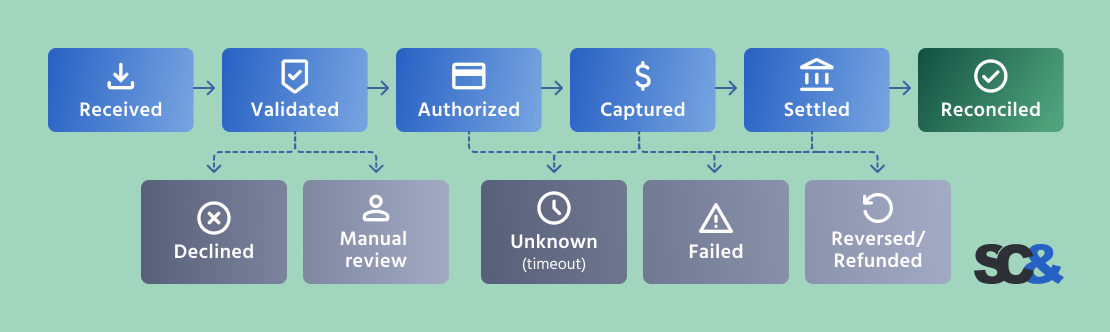
- Received. The customer clicks “Pay,” and the TPS registers the request with a unique transaction identifier. If the connection drops and the customer tries again, the system must recognize the original payment to avoid duplicate charges.
- Validated. Before contacting the bank, the platform checks the payment details and applicable compliance rules. Depending on the results, the request can proceed, be declined, or enter manual review if additional investigation is required.
- Authorized. Next, the issuing bank approves or declines the payment. For example, insufficient funds may lead to a decline, while an approved authorization allows the merchant to continue without confirming final settlement.
- Captured. Once the order is ready for processing, the merchant requests capture against the authorization. An expired authorization or incorrect capture amount can prevent the payment from moving forward.
- Settled. The captured payment enters the applicable clearing and settlement process. However, the merchant may still be waiting for funds or final confirmation, even though the customer has already received an order confirmation.
- Reconciled. Later, the finance system compares internal payment records with the provider’s settlement report. Any missing transaction, unexpected fee, or amount mismatch becomes an exception requiring investigation rather than an unnoticed accounting error.
Handling Alternative Transaction States
Not every payment follows the successful path. Depending on where the problem occurs, the TPS must distinguish between several outcomes:
- Declined: The request fails validation, or the issuing bank refuses authorization.
- Failed: A technical or processing error prevents a step from completing.
- Unknown: A timeout leaves the actual result unconfirmed.
- Reversed / Refunded: An authorization is released or a separate refund returns funds after capture or settlement, depending on the payment flow.
The unknown state is particularly dangerous. If the bank processes the €100 charge but its response never arrives, immediately repeating the request could charge the customer twice. Instead, the TPS must verify the original transaction’s status before taking further action.
Transaction Processing System Architecture for Fintech
A fintech TPS must coordinate payment execution across internal services and external providers without losing track of transaction states. The main architectural challenge is keeping financial records consistent when a request fails, a provider times out, or a service becomes unavailable.
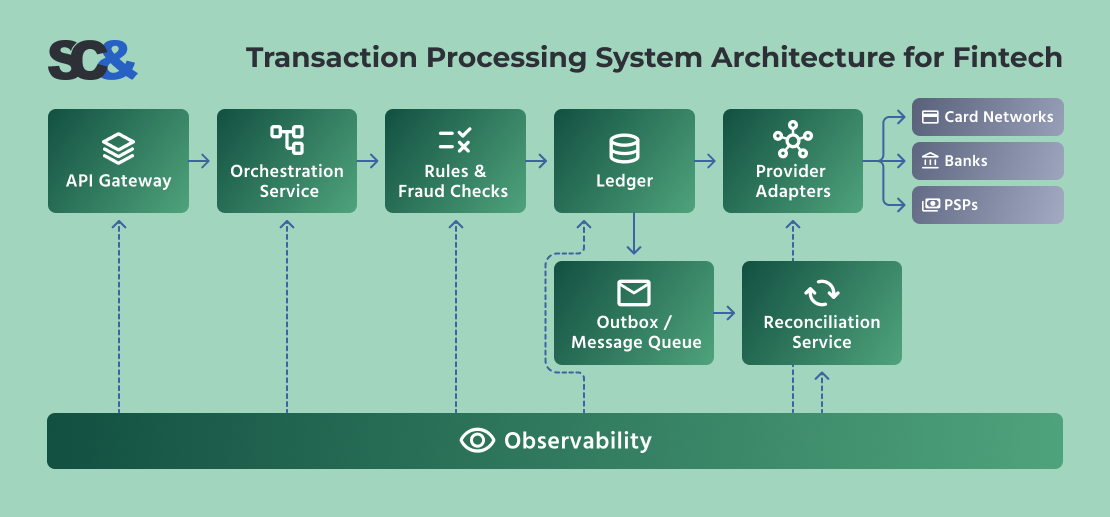
Each component addresses a specific processing risk. The table shows how these responsibilities are divided and what can happen when the corresponding controls are missing.
| Component | What It Does | What Can Go Wrong Without It |
| API Gateway | Authenticates requests, validates inputs, and controls traffic. | Invalid requests or traffic spikes can overwhelm payment services. |
| Orchestration Service | Coordinates processing steps and tracks transaction states. | Payments may remain unfinished or trigger duplicate provider calls. |
| Rules and Fraud Checks | Evaluates transaction limits, fraud risks, and compliance requirements. | Suspicious or unauthorized operations may reach execution. |
| Ledger | Records financial movements and maintains account balances. | Internal balances may disagree with actual financial activity. |
| Provider Adapters | Connects the TPS to banks, card networks, and PSPs through APIs. Our payment gateway integration expertise and API development services cover these connections. See also how to integrate a payment gateway. | Inconsistent provider responses can cause failed requests or incorrect transaction statuses. |
| Outbox / Message Queue | Records and delivers transaction events to downstream services. | A payment may be committed without notifying other systems. |
| Reconciliation Service | Matches internal records against external statements and settlement reports. | Missing payments or incorrect amounts may go undetected. |
| Observability | Tracks transaction activity through logs, metrics, and distributed traces. | Engineers cannot reliably locate failures or investigate stuck transactions. |
Centralized vs Distributed Architecture
A system with a shared transactional database simplifies atomic updates and debugging. Distributed services can scale independently, but maintaining consistency across them requires additional mechanisms.
For example, a SAGA coordinates multi-service operations and their compensating actions, while a transactional outbox helps prevent lost events. Neither removes the need for idempotency.
The architectural choice should reflect actual transaction volume, integration complexity, and failure requirements. Splitting a TPS into microservices too early can introduce consistency problems that a centralized design would avoid. See the challenges of microservice architecture.
From Our Practice
In our SEPA compliance middleware project, SCAND used Apache Kafka for payment-message ingestion and sharded MongoDB to store screening results for auditing and reporting. Active-active failover is an architecture in which multiple instances process traffic concurrently, allowing operations to continue during maintenance or local hardware failures. The solution supported SaaS and on-premises deployment.
Engineering for Correctness: How to Avoid Lost and Duplicate Transactions
The costliest TPS failures often happen between services rather than inside business logic: a client retries a request, a bank stops responding, or a message fails to reach its destination after a database update. Each event raises the same question: what actually happened, and how can the system avoid moving money twice? Idempotency, coordination patterns, and financial controls answer it together.
Idempotency and Idempotency Keys
Idempotency is the property that repeating an operation produces no additional effects beyond its first execution. An idempotency key is a unique identifier that lets a server recognize repeated requests for the same business operation.
Imagine a customer paying €100 online. The bank processes the charge, but the connection drops before confirmation arrives, and the customer clicks “Pay” again. An idempotent payment API handles this as follows:
POST /payments

Idempotency-Key: pay-order-847
- The client submits a payment request with a unique key.
- The server reserves the key and associates it with the transaction.
- The payment executes, but the response is lost.
- The client retries with the same key and receives the original result or current status, without a second payment.
For this mechanism to work, the server must store the key alongside the request parameters and transaction outcome. Concurrent retries also need protection, while reusing a key with different parameters should trigger an error.
How long should keys be retained? The answer depends on the retry window and payment workflow. For reference, Stripe documents a minimum retention period of 24 hours for its API idempotency keys. Internal transaction identifiers may need to remain available much longer.
Importantly, local idempotency does not automatically prevent duplication at an external bank. The TPS must also preserve provider references and respect the provider’s retry rules.
Timeouts and Unknown States
Idempotency addresses repeated requests, but the TPS may still not know whether an external provider completed the original payment. A bank may process a transfer while its response disappears, so the money may already have moved.
A timeout must therefore produce an unknown state, not an automatic failure. The TPS keeps the original transaction reference, queries the provider’s status API or waits for a verified webhook, and only then decides whether to retry, cancel, or escalate. Otherwise, recovery may create the duplicate charge it was meant to prevent.
Consistency Across Services: 2PC, SAGA, and Transactional Outbox
A payment provider may report successful collection while the order service fails before confirming the purchase. Database transactions cannot undo actions performed by independent providers, so distributed systems need extra coordination.
- Two-phase commit (2PC) is a protocol that asks participating transactional resources to prepare changes before coordinating their final commit or rollback.
- A SAGA is a sequence of local transactions that uses compensating actions when later steps fail.
- A transactional outbox is a pattern that stores an outgoing event in the same database transaction as the corresponding business update, allowing the event to be published afterward.
| Pattern | How It Works | When to Use | Trade-off |
| 2PC | Participants prepare changes before a coordinated commit. | Databases supporting distributed transactions | Coordination overhead and potential blocking |
| SAGA | Local transactions execute separately, with compensation after failures. | Multi-service workflows | More complex state handling and compensation |
| Transactional Outbox | Business changes and outgoing events are stored atomically. | Reliable event delivery between services | Consumers must handle duplicate events |
For external banks and providers, 2PC is generally unavailable, so a SAGA coordinates the workflow while an outbox preserves the events downstream services must receive. If payment collection succeeds but fulfillment fails, the SAGA may initiate a refund. Compensation is not a database rollback: a refund is a new financial operation with its own status, possible failures, and audit trail.
Double-Entry Ledger
A double-entry ledger is an accounting system in which each posted transaction contains balanced debit and credit entries, so total debits equal total credits for each currency. Moving €100 between two wallets creates matching entries that must be committed together.
Engineers derive balances from ledger entries instead of treating a mutable balance field as the source of truth, and correct errors with reversing or adjusting entries rather than overwriting history. Even a balanced ledger does not prove that the bank processed every payment correctly, which is why records must also be checked externally.
Reconciliation
Reconciliation is the process of comparing internal financial records with bank statements or payment-provider reports to identify and resolve discrepancies. As BCG notes, payment investigations and exception handling remain areas where financial organizations rely on manual work.
Daily reconciliation is a practical baseline, with more frequent checks where settlement schedules or risks require them. Expected differences, such as provider fees, follow predefined rules, while unexplained discrepancies enter a tracked investigation queue.
From our practice
In our UK Energy ERP modernization project, SCAND implemented functionality for reconciling transactional data against records from an industry operator. The project was outside fintech, but the challenge is the same: independently maintained records must be compared and discrepancies resolved.
Reconciliation closes the loop between execution and financial reporting, allowing a TPS to explain what happened to each operation, including those interrupted by failures.
One of the most dangerous mistakes in payment processing is assuming that a timeout means failure. A missing response tells you nothing about whether the provider executed the transaction.
Failure Scenarios and How a TPS Should Handle Them
Even a correct flow can fail when requests repeat, providers stop responding, or infrastructure goes down. The table shows common scenarios and the mechanisms a TPS needs to recover without losing or duplicating transactions.
| Scenario | What Goes Wrong | Correct Handling |
| Client retries after a network error | The original payment may have succeeded, creating a risk of duplicate charges | Reuse the idempotency key and return the existing transaction result or status |
| Provider timeout | The bank may have processed the payment without returning confirmation. | Mark the outcome as unknown and verify it through a status API or webhook before retrying. |
| Partial failure between services | One service commits a change while another fails to complete its step. | Use SAGA compensation or controlled retries, with a transactional outbox for reliable event delivery. |
| Webhook arrives twice or out of order | Duplicate or delayed events can overwrite a newer transaction status. | Deduplicate events and enforce valid state transitions using event identifiers and ordering rules. |
| Ledger and bank statement do not match | Internal records differ from the provider’s reported amounts or statuses. | Run reconciliation, investigate unmatched entries, and correct errors through auditable adjustments. |
| Hot account under peak load | Concurrent transactions compete for the same balance, causing contention or incorrect updates. | Serialize conflicting updates or use concurrency controls with bounded retries and backpressure. |
| Node or data center failure | In-flight requests are interrupted, and another instance may lack the latest confirmed state. | Fail over to a healthy instance using durable, appropriately replicated state; recover and verify unfinished transactions. |
A successful local update is not proof that the whole transaction is complete: the TPS must preserve enough information to establish the actual outcome before acting further.

Security and Compliance
Security and compliance in a fintech TPS require protecting payment data, controlling access, and screening transactions before execution. In banking software development, these safeguards must be built into transaction processing without creating unnecessary delays or gaps in the audit trail.
Protecting Payment Data
Tokenization replaces sensitive card details with references that cannot independently reveal the original information. Encryption protects data during transmission and storage, while role-based permissions restrict access to authorized services and employees.
Equally important, tamper-evident audit logs preserve transaction histories and record who accessed or changed critical information. Such records help investigators reconstruct incidents without relying on application logs alone.
Fraud Detection and AML Screening
Fraud prevention should balance response time with investigative depth. Fast rules can check transaction limits and known risk indicators synchronously, while deeper analysis runs asynchronously when immediate intervention is unnecessary.
However, required pre-execution controls cannot be deferred. In the relevant payment flow, AML screening evaluates transfers before they proceed, while flagged transactions are blocked or routed for further review.
From our practice
In our SEPA compliance middleware project, SCAND implemented pre-execution AML screening with three possible outcomes: Accepted, Suspicious, and Manual Review. Accepted payments proceeded automatically, suspicious payments were blocked, and only transactions requiring further investigation were routed to specialists.
Regulatory and Industry Requirements
- PCI DSS v4.0.1 defines security requirements for environments handling payment card data.
- PSD2 establishes payment-service requirements, including strong customer authentication where applicable.
- ISO 20022 provides the financial messaging framework used by SEPA payment schemes.
- EU AML requirements establish risk-based controls against money laundering, with the cited regulation applying from July 2027. For a practical view, see AML challenges and opportunities for neobanks.
- SOC 2 provides an attestation framework for evaluating service-organization controls.
- GDPR governs personal data processing and requires security measures appropriate to the risks.
For TPS architects, these requirements influence where sensitive data is stored, which services can access it, and when transactions must pause for verification. They also shape authentication flows and audit logging, making compliance an architectural consideration rather than a final release check.
Performance and Scaling
At the end of the month, thousands of salary payments may enter a banking system within minutes. The sudden load can fill processing queues, slow database operations, and delay responses from external providers. To design a scalable payment system, engineering teams must account for these traffic spikes and ensure that a fintech TPS can handle them without losing transactions or compromising financial accuracy.
Measure Tail Latency, Not Just Averages
Average response time can hide delays affecting individual payments. Engineers therefore track p95 and p99 latency to understand how long the slowest 5% and 1% of requests take to complete.
These metrics help distinguish an isolated delay from a wider processing problem. For example, rising p99 latency may reveal database contention or slow provider responses even when the average response time remains stable.

Prepare for Peak Transaction Loads
Queues help absorb bursts of incoming payments, while rate limiting prevents downstream services from becoming overloaded. However, queued transactions still need processing capacity. Without backpressure and capacity controls, a temporary spike can turn into a growing backlog.
Before release, load testing should reproduce realistic payment patterns, including retries, simultaneous transfers, and provider slowdowns. Stress tests can then reveal how the system behaves when demand exceeds its available capacity.
Another challenge is the hot account: a single account receiving many concurrent updates. Partitioning data by account distributes workloads, but transactions targeting the same balance still require coordinated updates to prevent conflicting writes.
From Our Practice
In SCAND’s SEPA compliance middleware project, on-premises deployments processed tens of thousands of SEPA requests per second. Kafka-based ingestion and sharded MongoDB supported high-volume processing during peaks such as end-of-month salary runs.
The architecture also used active-active failover to maintain processing availability during maintenance or infrastructure failures.
Build or Buy a Transaction Processing System
Building a custom TPS makes sense when existing platforms cannot support the required transaction rules, ledger structure, or recovery logic. Otherwise, extending a ready-made system may be less expensive and easier to maintain than replacing it. When a rebuild is justified, custom software development lets the team define the ledger, state model, and recovery logic.
The decision often arises during modernization. According to J.P. Morgan and ASUG, 87% of surveyed organizations use some automation in treasury and payments infrastructure, but only 39% describe their systems as mostly or fully automated.
However, incomplete automation does not necessarily justify rebuilding the transaction core. Engineers first need to identify which limitations come from the platform itself and which can be addressed through additional services.
| Option | When It Fits | Trade-off |
| Ready-Made Core Banking or Payment Platform | Standard payment flows that fit the vendor’s processing model | Reduces initial development, but introduces licensing costs, vendor dependencies, and constraints on transaction logic. |
| Custom TPS | Products requiring specialized ledgers, transaction states, or provider orchestration | Gives control over financial data and recovery mechanisms, but requires ongoing investment in operations, security, testing, and compliance updates. |
| Hybrid Approach | Existing infrastructure needs additional screening, integrations, or processing rules | Retains the transaction core, but introduces coordination challenges, additional failure points, and reconciliation across system boundaries |
Start with where financial truth will reside: if a new component keeps its own ledger or transaction states, the architecture must define how they stay consistent with the core platform.
Then count provider integrations, since a custom TPS means maintaining API adapters and investigating uncertain payment outcomes, and include maintenance, monitoring, reconciliation, and compliance updates in the cost. A hybrid approach reduces the scope of replacement only when its benefits outweigh the complexity of coordinating two systems.
How SCAND Builds Transaction Systems
Transaction processing presents different challenges across banking, trading, and enterprise systems, from payment screening to transaction execution and financial reconciliation. SCAND addresses these challenges through our financial software development projects, while our fintech software development services also cover core processing systems, provider integrations, and compliance controls. The following projects show how these capabilities work in practice.
SEPA Compliance Middleware for High-Load Banking Pipelines
Processing large SEPA batches required a European bank to screen individual transfers before execution without slowing its payment pipeline. SCAND built middleware that splits batches, applies AML rules, and processes messages using Apache Kafka, with sharded MongoDB and active-active failover.
On-premises deployments handle tens of thousands of requests per second, while automated screening limits manual intervention and the architecture supports SaaS deployment.
Online Digital Banking Platform (BaaS)
Banking-as-a-service introduces a different challenge: combining financial operations with customer onboarding and third-party integrations. For a BaaS provider, SCAND delivered a digital banking platform and iOS and Android applications supporting KYC checks, cryptocurrency transactions, and an external partner API. The platform also includes horizontal scaling capabilities and was prepared for PCI DSS certification.
Biomass Trading Platform (BioExchange)
A national biomass exchange needed to manage trading orders, match buyers and sellers, and handle payments and participant security funds. SCAND developed a background matching engine, transaction workflows, and separate interfaces for participants and operators on AWS infrastructure. The MVP reached production in 3.5 months, with further development continuing after launch.
UK Energy ERP Modernization
Reconciling financial records was one part of a broader legacy modernization project for a UK energy business. SCAND developed an ERP platform that integrates more than 50 external data sources, compares transaction records with industry-operator data, and automates invoice calculations and generation.
Parallel operation with the legacy environment allowed functionality to be introduced gradually without interrupting business operations.
Frequently Asked Questions (FAQs)
What is the definition of a transaction processing system?
A transaction processing system (TPS) is software that executes business operations and records their outcomes. In fintech, it processes payments, transfers, and trading orders while maintaining accurate transaction states. The system must also handle failed requests, prevent duplicate execution, and preserve financial records when individual components become unavailable.
What are the main types of transaction processing systems?
The main types are real-time, batch, and hybrid transaction processing systems. Real-time systems process requests immediately, while batch systems handle accumulated operations together. Hybrid systems combine both approaches, as in card payments where authorization happens immediately but clearing and settlement follow separate processing schedules.
What is idempotency in payment processing?
Idempotency is the property that repeating a payment request does not create additional financial effects. A client sends an idempotency key with the original request, allowing the server to recognize retries. If a network error interrupts the response, the system can return the existing result without initiating another charge.
How do ACID properties make a TPS reliable?
ACID properties protect the consistency of database transactions through atomicity, consistency, isolation, and durability. Together, they prevent partial commits, enforce integrity rules, control concurrent changes, and preserve committed records after failures. However, ACID alone cannot guarantee correctness across independent banks or services, where additional coordination mechanisms are necessary.
What is the difference between a TPS and an analytical system?
A TPS executes and records individual business operations, while an analytical system examines accumulated data for reporting and decision-making. Transactional databases prioritize short updates and predictable response times. Analytical systems handle complex queries across historical records, so separating these workloads helps prevent reporting activity from slowing payment processing.
How often should a payment system run reconciliation?
Payment systems should generally perform reconciliation at least daily, with more frequent checks when transaction volumes, settlement schedules, or operational risks require them. Reconciliation compares internal ledger entries against bank statements and provider reports. Unmatched transactions should be investigated promptly rather than carried forward without explanation.
How much does it cost and how long does it take to build a transaction processing system?
The cost and timeline depend on how much transaction processing the system must handle. SCAND's fintech estimates start at $50,000 for basic applications and exceed $300,000 for complex platforms. A trading platform MVP took 3.5 months, although TPS development requires individual estimates based on integrations, compliance, and availability. Learn more about building a banking MVP.